
Latest Post
Showing posts with label space. Show all posts
Showing posts with label space. Show all posts
Sun BELCHES twice, mighty plasma loops miss Earth - NASA vid
Written By Unknown on Monday, November 19, 2012 | 4:35 PM
The Sun lashed out with two plasma eruptions one after the other early on Friday morning.

NASA's Solar Dynamic Observatory (SDO) spotted the solar flares, when red-hot loops of plasma burst out of the surface of the Sun.
The flares both happened within a four-hour window between 6am and 10am GMT, when prominences in the Sun became unstable and belched out hot gas made of electrically charged hydrogen and helium.
During a flare, the plasma flows out along a tangled and twisted structure of magnetic fields generated by the Sun's internal dynamo.
According to NASA:
The action was captured in the 304 Angstrom wavelength of extreme ultraviolet light. It seems possible that the disruption to the Sun’s magnetic field might have triggered the second event since they were in relatively close proximity to each other.
Luckily, the flares were not aimed at Earth, but spewed out into space. Had the resulting particle clouds been headed for us, there could have been issues for spacecraft and astronauts in orbit, though the only effect normally seen for most of us is boosted polar aurorae. ®
By Brid-Aine Parnell
http://www.theregister.co.uk/
Asteroid 'Nibiru' On Collision Course With Earth, According To NASA Whistleblowers
Written By Unknown on Wednesday, November 7, 2012 | 1:31 PM

According to leaks by unnamed NASA employees and scientists, an asteroid dubbed 'Nibiru' is heading in a direct path towards earth, with up to 30% chance of collision. Understandably NASA is keeping quiet for the moment as to not incite panic, and to get all the facts before making an official press release.
Though some unconfirmed rumours include the asteroid being the size of texas, and the estimated date of collision being some time during November-December 2012. NASA has neither confirmed or denied any of these claims.
http://ireport.cnn.com/docs/DOC-872812
Rapid changes in the Earth's core: The magnetic field and gravity from a satellte perspective
Written By Unknown on Monday, November 5, 2012 | 7:09 PM

Annual to decadal changes in the earth’s magnetic field in a region that stretches from the Atlantic to the Indian Ocean have a close relationship with variations of gravity in this area. From this it can be concluded that outer core processes are reflected in gravity data. This is the result presented by a German-French group of geophysicists in the latest issue of PNAS (Proceedings of the National Academy of Sciences of the United States).
The main field of the Earth’s magnetic field is generated by flows of liquid iron in the outer core. The Earth’s magnetic field protects us from cosmic radiation particles. Therefore, understanding the processes in the outer core is important to understand the terrestrial shield. Key to this are measurements of the geomagnetic field itself. A second, independent access could be represented by the measurement of minute changes in gravity caused by the fact that the flow in the liquid Earth’s core is associated with mass displacements. The research group has now succeeded to provide the first evidence of such a connection of fluctuations in the Earth’s gravity and magnetic field.
They used magnetic field measurements of the GFZ-satellite CHAMP and extremely accurate measurements of the Earth’s gravity field derived from the GRACE mission, which is also under the auspices of the GFZ. “The main problem was the separation of the individual components of the gravity data from the total signal,” explains Vincent Lesur from the GFZ German Research Centre for Geosciences, who is involved in the study. A satellite only measures the total gravity, which consists of the mass fractions of Earth’s body, water and ice on the ground and in the air. To determine the mass redistribution by flows in the outer core, the thus attained share of the total gravity needs to be filtered out. “Similarly, in order to capture the smaller changes in the outer core, the proportion of the magnetic crust and the proportion of the ionosphere and magnetosphere need to be filtered out from the total magnetic field signal measured by the satellite,” Vincent Lesur explains. The data records of the GFZ-satellite missions CHAMP and GRACE enabled this for the first time.
During the investigation, the team focused on an area between the Atlantic and the Indian Ocean, as the determined currents flows were the highest here. Extremely fast changes (so-called magnetic jerks) were observed in the year 2007 at the Earth’s surface. These are an indication for sudden changes of liquid flows in the upper outer core and are important for understanding the magneto-hydrodynamics in the Earth’s core. Using the satellite data, a clear signal of gravity data from the Earth’s core could be received for the first time.
This results in consequences for the existing conceptual models. Until now, for example, it was assumed that the differences in the density of the molten iron in the earth’s core are not large enough to generate a measurable signal in the earth’s gravitational field. The newly determined mass flows in the upper outer core allow a new approach to Earth’s core hydrodynamics.
scienceblog.com
Massive Black Hole May Exist Near Earth
Written By Unknown on Thursday, November 1, 2012 | 5:00 PM
The strange behavior of stars in the Sword of Orion may be due to the presence of a black hole about 200 times larger than our sun.

Overview image of the Orion Nebula with the star cluster at its center. The possible black hole would reside somewhere between the four bright stars which mark the cluster's center. These stars form the famous Trapezium of the Orion Nebula Cluster. (NASA/ESA/Hubble Space Telescope)
Using computer modelling, an international team of astronomers studied these fast-moving stars that form the Orion Nebula Cluster.
There appear to be too few high-mass stars in the cluster relative to low-mass stars, and they are moving at high speeds as if the whole group is flying apart.
“These properties have been a puzzle to astronomers, given all the knowledge that they have about how stars are formed and distributed,” said study co-author Holger Baumgardt at Australia’s University of Queensland in a press release.
The model consisted of a dense cloud of interstellar gas with the right proportion of heavy and light stars. Thus their motion could be calculated, showing that the cluster expands as the gas moves outwards.
Many heavy stars were thrown out, and some moved to the center, colliding with the most massive star there.
“Our scenario neatly accounts for virtually all observed properties of the Orion Nebula Cluster, that is, its low number of high-mass stars, and its rapidly-moving central stars, and suggests that the massive stars near the center of this cluster are bound by a black hole,” said study lead author Ladislav Subr at Charles University, Prague, in the release.
The black hole would have formed when the massive star became unstable.
“Having such a massive black hole at our doorstep would be a dramatic chance for intense studies of these enigmatic objects,” said study co-author Pavel Kroupa at Germany’s University of Bonn in the release.
The study was published in The Astrophysical Journal.
www.theepochtimes.com
Meteor falls from sky near Stanwood
King5 News/NWCN.com; Thu, 01 Nov 2012 11:55 CDT. Halloween proved to be an interesting night for law enforcement in at least four Western Washington counties after reports of a meteor falling to Earth.

© Renata Arpasova, CNN
The Snohomish County Sheriff's Office said deputies investigated a possible meteor falling somewhere near I-5 and Exit 212, between Stanwood and Arlington. K9 Officers also responded, but nothing was found.
Deputies cleared the scene, but said they "[assume] it is a meteor, unless we hear otherwise."
Bill Gillam from Arlington said on Twitter, "Sounds like a meteor, space junk or aliens entered Washington airspace somewhere in Skagit County." He went on to say, "Last report was Hamilton in Skagit County."
An Arlington police officer confirmed seeing something fall from the sky. Viewers also emailed KING 5 News from Gig Harbor and Burien saying they also saw it.
The Federal Aviation Administration said they also fielded calls from people who reported they saw a meteor.
So far, nothing has been found.
NASA'S Fermi Measures Cosmic 'Fog' Produced by Ancient Starlight
ScienceDaily (Nov. 1, 2012) — Astronomers using data from NASA's Fermi Gamma-ray Space Telescope have made the most accurate measurement of starlight in the universe and used it to establish the total amount of light from all of the stars that have ever shone, accomplishing a primary mission goal.

This illustration places the Fermi measurements in perspective with other well-known features of cosmic history. Star formation reached a peak when the universe was about 3 billion years old and has been declining ever since. (Credit: NASA's Goddard Space Flight Center)
Gamma rays are the most energetic form of light. Since Fermi's launch in 2008, its Large Area Telescope (LAT) observes the entire sky in high-energy gamma rays every three hours, creating the most detailed map of the universe ever known at these energies.
The total sum of starlight in the cosmos is known to astronomers as the extragalactic background light (EBL). To gamma rays, the EBL functions as a kind of cosmic fog. Ajello and his team investigated the EBL by studying gamma rays from 150 blazars, or galaxies powered by black holes, that were strongly detected at energies greater than 3 billion electron volts (GeV), or more than a billion times the energy of visible light.
"With more than a thousand detected so far, blazars are the most common sources detected by Fermi, but gamma rays at these energies are few and far between, which is why it took four years of data to make this analysis," said team member Justin Finke, an astrophysicist at the Naval Research Laboratory in Washington.
As matter falls toward a galaxy's supermassive black hole, some of it is accelerated outward at almost the speed of light in jets pointed in opposite directions. When one of the jets happens to be aimed in the direction of Earth, the galaxy appears especially bright and is classified as a blazar.
Gamma rays produced in blazar jets travel across billions of light-years to Earth. During their journey, the gamma rays pass through an increasing fog of visible and ultraviolet light emitted by stars that formed throughout the history of the universe.
Occasionally, a gamma ray collides with starlight and transforms into a pair of particles -- an electron and its antimatter counterpart, a positron. Once this occurs, the gamma ray light is lost. In effect, the process dampens the gamma ray signal in much the same way as fog dims a distant lighthouse.
From studies of nearby blazars, scientists have determined how many gamma rays should be emitted at different energies. More distant blazars show fewer gamma rays at higher energies -- especially above 25 GeV -- thanks to absorption by the cosmic fog.
The farthest blazars are missing most of their higher-energy gamma rays.
The researchers then determined the average gamma-ray attenuation across three distance ranges between 9.6 billion years ago and today.
From this measurement, the scientists were able to estimate the fog's thickness. To account for the observations, the average stellar density in the cosmos is about 1.4 stars per 100 billion cubic light-years, which means the average distance between stars in the universe is about 4,150 light-years.
A paper describing the findings was published Thursday on Science Express.
"The Fermi result opens up the exciting possibility of constraining the earliest period of cosmic star formation, thus setting the stage for NASA's James Webb Space Telescope," said Volker Bromm, an astronomer at the University of Texas, Austin, who commented on the findings. "In simple terms, Fermi is providing us with a shadow image of the first stars, whereas Webb will directly detect them."
Measuring the extragalactic background light was one of the primary mission goals for Fermi.
"We're very excited about the prospect of extending this measurement even farther," said Julie McEnery, the mission's project scientist at NASA's Goddard Space Flight Center in Greenbelt, Md.
Goddard manages the Fermi astrophysics and particle physics research partnership. Fermi was developed in collaboration with the U.S. Department of Energy with contributions from academic institutions and partners in France, Germany, Italy, Japan, Sweden and the United States.
Journal Reference:
Ackermann et al. The Imprint of the Extragalactic Background Light in the Gamma-Ray Spectra of Blazars. Science, 2012; DOI: 10.1126/science.1227160
http://www.sciencedaily.com
The Sun Also Surprises
Written By Unknown on Tuesday, October 30, 2012 | 3:51 PM

Occasionally, a large solar storm can rain energy down on the earth, overpowering electrical grids. About once a century, a giant pulse can knock out worldwide power systems for months or even years. It’s been 90 years since the last super storm, but scientists say we are on the verge of another period of high solar activity.
This isn’t science fiction. Though less frequent than large hurricanes, significant storms have hit earth several times over the last 150 years, most notably in 1859 and 1921. Those occurred before the development of the modern power grid; recovering from a storm that size today would cost up to $2 trillion a year for several years.
Storms don’t have to be big to do damage. In March 1989 two smaller solar blasts shut down most of the grid in Quebec, leaving millions of customers without power for nine hours. Another storm, in 2003, caused a blackout in Sweden and fried 14 high-voltage transformers in South Africa.
The South African experience was particularly telling — the storm was relatively weak, but by damaging transformers it put parts of the country off-line for months. That’s because high-voltage transformers, which handle enormous amounts of electricity, are the most sensitive part of a grid; a strong electromagnetic pulse can easily fuse their copper wiring, damaging them beyond repair.
Even worse, transformers are hard to replace. They weigh up to 100 tons, so they can’t be easily moved from the factories in Europe and Asia where most of them are made; right now, there’s already a three-year waiting list for new ones.
Without aggressive preparation, we run the risk of a disaster magnitudes greater than Hurricane Katrina. Little or no electricity means little or no telecommunications, refrigeration, clean water or fuel. Basic law enforcement and national security could be compromised.
Fortunately, there are several defenses against solar storms. The most important are grid-level surge suppressors, which are essentially giant versions of the devices we use at home to protect computers. There are some 5,000 vulnerable transformers in North America; at $50,000 for each suppressor, we could protect the grid for about $250 million.
Earlier this year the House of Representatives passed a bill that would allow the White House to require utilities to put grid-protection measures in place, then recoup the costs from customers. Unfortunately, the companion bill in the Senate contains no such provision.
It’s not a lost cause, though; lawmakers can still insert the grid-protection language during conference. If they don’t, there could be trouble soon: the next period of heavy solar activity will be in late 2012. Having gone unprepared for one recent natural disaster, we would make a grave mistake not to get ready for the next.
By LAWRENCE E. JOSEPH,Los Angeles,www.nytimes.com
Lawrence E. Joseph is the author of “Aftermath: A Guide to Preparing for and Surviving Apocalypse 2012.”
Hurricane Sandy Seen From Space - Video - Space.com
Written By Unknown on Monday, October 29, 2012 | 2:31 PM

The hurricane that is threatening the east coast of the United States was seen by the crew aboard the International Space Station. Meteorologists are worried this storm and a winter storm coming from the west will form a devastating "Frankenstorm".Credit: NASA
After-effects of Saturn’s super storm shine on
Written By Unknown on Sunday, October 28, 2012 | 1:38 PM
The ground-based observations were made by the Very Large Telescope of the European Southern Observatory in Chile, and NASA’s Infrared Telescope Facility at the summit of Mauna Kea in Hawaii.
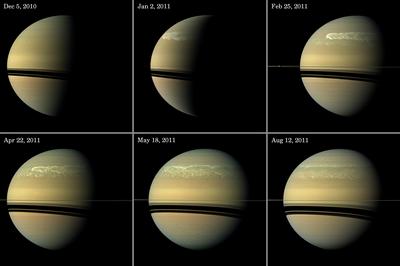
The vivid cloud structures that wreaked havoc across wide swathes of the mid-northern latitudes of Saturn’s atmosphere captured the imaginations of amateur and professional astronomers alike, from its first appearance in December 2010 through much of 2011.
But in new reports that focus on the temperatures, winds and composition of Saturn’s atmosphere, scientists find that the spectacular cloud displays were only part of the story.
Evolution of infrared hotspots in Saturn’s springtime storm
“It’s the first time we’ve seen anything like it on any planet in the Solar System,” says Leigh Fletcher from the University of Oxford, UK, lead author of the Icarus paper.
“It’s extremely unusual, as we can only see the vortex at infrared wavelengths – we can’t tell that it is there simply by looking at the cloud cover.”
As the visible storm erupted in the roiling cloud deck of Saturn’s troposphere, waves of energy rippled hundreds of kilometres upwards, depositing their energy as two vast ‘beacons’ of hot air in the stratosphere.
The beacons were expected to cool down and dissipate, but by late April 2011 – by which time bright cloud material had encircled the entire planet – the hot spots had merged to create an enormous vortex that for a brief period exceeded even the size of Jupiter’s famous Great Red Spot.
Furthermore, the temperature of the vortex was far higher than expected, some 80ºC warmer than the surrounding atmosphere. At the same time, huge spikes in the amount of gases like ethylene and acetylene were detected.
Looking down on Saturn’s storm
Much like the Great Red Spot, Saturn’s vortex also cuts off the atmosphere in its core from the surrounding environment, constraining its unique chemistry and high temperatures within the walls of the powerful winds whipping around the edge.
“But Jupiter’s vortex is embedded deep down in the turbulent ‘weather zone’, whereas the vast vortex on Saturn is higher up in the atmosphere where, normally, you wouldn’t expect anything like it to have formed,” says Dr Fletcher.
“Although there are parallels to be drawn between the two, the mechanisms by which they were formed and the length of time they are going to exist seem to be very different.”
Jupiter’s famous vortex has raged for at least 300 years, but after traversing the planet once every 120 days since May 2011, Saturn’s large beacon is cooling and shrinking. Scientists expect it to fade away completely by the end of 2013.
The question now remains as to whether Saturn’s storm-generating energy has been sapped or if there will be a repeat performance.
The outburst already caught observers by surprise by arriving during the planet’s northern hemisphere spring, years ahead of the predictably stormy summer season.
“The beauty is that Cassini will be operating until the Saturn system reaches its summer solstice in 2017, so if there is another global event like this, we’ll be there to see it,” says ESA’s Cassini project scientist Nicolas Altobelli.
http://www.esa.int


