
Latest Post
Showing posts with label Climate Change. Show all posts
Showing posts with label Climate Change. Show all posts
Warming Temperatures Will Change Greenland's Face, Experts Predict
Written By Unknown on Sunday, November 18, 2012 | 8:16 PM

Professor Marco Tedesco balances at the edge of a supraglacial lake. (Credit: Copyright M. Tedesco/WWF)
Global climate models abound. What is harder to pin down, however, is how a warmer global temperature might affect any specific region on Earth.
Dr. Marco Tedesco, associate professor of earth and atmospheric sciences at The City College of New York, and a colleague have made the global local. Using a regional climate model and the output of three global climate models, they can predict how different greenhouse gas scenarios would change the face of Greenland over the next century and how this would impact sea level rise.
The resulting fine-scale model gives a high-resolution picture of the island's future. "We put Greenland under a microscope to see what accounts for melting and for ice mass changes in different regions," said Professor Tedesco.
He and his colleague, Xavier Fettweis of the University of Liege, Belgium, reported their results online November 8 in Environmental Research Letters.
They compared two possible future CO2 scenarios: a concentration of carbon dioxide in the atmosphere projected for the end of the century of 850 parts per million (ppm) versus a more aggressive projection of 1370 ppm. The first approximates the current rate of increase.
The Greenland ice sheet would lose more ice and snow to melting than it would accumulate in both scenarios. Basins on the southwest and north coasts would suffer the greatest losses. Temperatures would only have to increase by 0.6 to 2.16 degrees Celsius (1.8-3.9 ° F) to tip the balance into more loss than gain.
The new model shows how a melting would alter the topography of "one of the world's refrigerators," potentially affecting adjacent ocean circulation and salinity, and speeding further melting.
Though dramatic, Professor Tedesco said the predictions he reported might be too conservative. "They don't take into account progressive effects of the changing elevations and topography and the acceleration of ice sheet movement." These results, however, represent a step forward toward understanding the potential repercussions of warming temperatures; an improvement on models that give a much coarser view into the future, he added.
"Some areas will be 400 meters below the current elevation just because of melting. This might very well impact the speed and amount of ice that is flowing to the ocean. It would increase the rate of melting, because conditions get warmer at lower elevations" he noted. "Imagine an ice cream that is melting much faster in one area. This will change the shape of the ice mass over Greenland."
This work was supported by the National Science Foundation.
www.sciencedaily.com
Land subsidence – flooding is the “global warming”
Written By Unknown on Wednesday, November 7, 2012 | 3:55 PM
Land subsidence – flooding is the “global warming“.

The story of climate change is no less interesting. Because now it has turned more and more to talk about this enough. Become subject to it. With the change of climate variability and change things around. Affect many. The story will be told today, there is another interesting story about land subsidence – caused flooding and many are caught off guard by it.
The “global warming” and its impact on the broader story is spread around. I had a talk entitled “The impact of global warming. That affect coastal Thailand “, there is another interesting story. The current growth of the industry. The amount of gas in the 21st century, it is expected that high temperature of 6 degrees Celsius, leading to the occurrence of hurricanes and natural disturbances that occur with. Polar ice is completely melted. Impact on the high seas rise with it. Will result in the production of natural food. Water in the summer is out there. Mosquitoes can be a severe disease with increased earthquake faults will be affected more and more by the earthquake, tsunami. Volcano to blow it up. There are also mega tsunami itself. Consequences to the Internet. There is more rain in flood bar high. This is an interesting story. Should be aware that we do more with it.
Although global warming may not affect us directly to Thailand at this time that But the effect is stronger the wind, waves, coastal erosion, 2815 km long, covering 23 provinces in the Gulf of Thailand have discovered that there is a crisis that has eroded the average over 5 meters / year that it is. areas with erosion rates of 1-5 m / year in 14 provinces.
The Andaman is a crisis that has eroded areas average more than 5 m / year in 5 provinces in areas with erosion rates of 1-5 m / year in the province was 90.5 km from exploiting it. appropriate Sediment accumulation less. The development of the information system based on land use change processes natural high enough.
This is a fascinating story that we come together today itself.
Thanks great article from writer.dek-d.com.
www.naomitosy.com
Heavy rain and floods in Slovenia
Written By Unknown on Tuesday, November 6, 2012 | 12:37 PM
Heavy rain in Slovenia has caused several regional roads, mostly in western Slovenia, to be closed due to flooding rivers, minor landslides and a number of fallen trees.


www.demotix.com

Floods in Slovenia caused a lot of trouble and fear among the population. Water has flooded many buildings and roads and triggered a series of landslides. It is closed several roads and rail links. Red alarm for large parts of the country. Centenary water: Severe clock on the Drava river, sirens and record levels of river flow. Dravograd suffered great disaster, black cut off from the world.Traffic information center for the State Highway on its website indicates that almost half of the roads in our country crippled by flood.
www.siol.net, poleshift.ning.com
Greenland May Soon Disappear
Written By Unknown on Monday, November 5, 2012 | 7:20 PM

A panel of scientists told Congress the entire ice mass of Greenland will disappear from the world map if temperatures rise by as little as 2C --3.6 degrees Fahrenheit, with severe consequences for the rest of the world.The fall-out would be felt thousands of miles away from the Arctic, unleashing a global sea level rise of 23 feet. Low-lying cities such as New Orleans would vanish.
Found: The Climate Change Trigger For Earth's Last Big Freeze
Did the flood waters from melting of the Laurentide Ice Sheet in the last major cold episode on Earth about 12,900 years ago flow northwest into the Arctic firs, or east via the Gulf of St. Lawrence to weaken ocean thermohaline circulation and have a frigid effect on global climate?
It's a debate that has gone on for decades but new, high-resolution global ocean circulation models claim to have an answer/ The researchers report that the flood must have flowed north into the Arctic first down the Mackenzie River valley. They also say that if it had flowed east into the St. Lawrence River valley, Earth's climate would have remained relatively unchanged.
Events leading up to the sharp climate-cooling period known as the Younger Dryas, colloquially known as the "Big Freeze," unfolded after glacial Lake Agassiz, at the southern edge of the Laurentide ice sheet covering Hudson Bay and much of the Canadian Arctic, catastrophically broke through an ice dam and dumped thousands of cubic kilometers of fresh water into the ocean in a short time.
This massive influx of frigid fresh water injected over the surface of the ocean is assumed to have halted the sinking of very dense, saltier, colder water in the North Atlantic that drives the large-scale ocean circulation, the thermohaline circulation, that transports heat to Europe and North America. The weakening of this circulation caused by the flood resulted in the dramatic cooling of North America and Europe.

A new model of flood waters from melting of the Laurentide Ice Sheet and large glacial lakes along its edge that covered much of North America from the Arctic south to New England over 13,000 years ago, shows the meltwater flowed northwest into the Arctic first. This weakened deep ocean circulation and led to Earth’s last major cold period. A new model of flood waters from melting of the Laurentide Ice Sheet and large glacial lakes along its edge that covered much of North America from the Arctic south to New England over 13,000 years ago, shows the meltwater flowed northwest into the Arctic first. This weakened deep ocean circulation and led to Earth’s last major cold period. Credit: Alan Condron, UMass Amherst
"This episode was the last time the Earth underwent a major cooling, so understanding exactly what caused it is very important for understanding how our modern-day climate might change in the future," University of Massachusetts Amherst geoscientist Alan Condron said in their statement.
They say their global, ocean-ice circulation model is 10 to 20 times more powerful than previously attainable, and it allowed them to compare how meltwater from the two different drainage outlets was delivered to the sinking regions in the North Atlantic. They found the original hypothesis proposed in 1989 by Wally Broecker of Columbia University suggesting that Lake Aggasiz drained into the North Atlantic down the St. Lawrence River would have weakened the thermohaline circulation by less than 15 percent.
Condron and Winsor say this level of weakening is unlikely to have accounted for the 1,000-year cold climate event that followed the meltwater flood. Meltwater from the St. Lawrence River actually ends up almost 1,900 miles (3,000 km) south of the deep water formation regions, too far south to have any significant impact on the sinking of surface waters, which explains why the impact on the thermohaline circulation is so minor.
By contrast, their model says that when the meltwater first drains into the Arctic Ocean, narrow coastal boundary currents can efficiently deliver it to the deep water formation regions of the sub-polar north Atlantic, weakening the thermohaline circulation by more than 30 percent. They conclude that this scenario, showing meltwater discharged first into the Arctic rather than down the St. Lawrence valley, is "more likely to have triggered the Younger Dryas cooling."
Condron adds, "Our results are particularly relevant for how we model the melting of the Greenland and Antarctic Ice sheets now and in the future. It is apparent from our results that climate scientists are artificially introducing fresh water into their models over large parts of the ocean that freshwater would never have reached. In addition, our work points to the Arctic as a primary trigger for climate change. This is especially relevant considering the rapid changes that have been occurring in this region in the last 10 years."
Published in Proceedings of the National Academy of Sciences.
www.science20.com
Dawn to Dusk: Hurricane Sandy, October 29, 2012, Super Rapid Scan
Written By Unknown on Thursday, November 1, 2012 | 2:44 PM
This time-lapse video shows the evolution of Hurricane Sandy from dawn to dusk on October 29, 2012. The video was compiled from satellite images taken every minute from 6:00 a.m. to 6:30 p.m. EDT.

The images were collected in "super rapid scan" mode by the GOES-14 satellite, which observes Earth from geostationary orbit (35,800 km or 22,300 miles) over the Western Hemisphere. The changing angles of sunlight highlight the motions and different structures in the clouds. GOES satellites are built by NASA and operated by the National Oceanic and Atmospheric Administration.
NASA animation by Kevin Ward, using images from NOAA and the University of Wisconsin-Madison Cooperative Institute for Meteorological Satellite Studies.
http://earthobservatory.nasa.gov
NASAEarthObservatory - www.youtube.com
Video of extreme global weather events and other weird phenomena in October 2012

Snow in Springtime in Australia; deluge in the UK, Nigeria, southern Spain and the US; fireballs seen everywhere; tornadoes and strong winds in southern France; another zombie cannibal attack, this time in China; a hurricane in northeastern US; UFOs diving into volcanoes; large earthquakes; sudden sinkholes swallowing and killing people in China ...it's been another bizarre month here on the Big Blue Marble.
fidockave213
YouTube
Tens of thousands flee homes as cyclone Nilam hits India

INDIA, CHENNAI : Onlookers gather on the beach after the oil tanker ship Pratibha Cauvery ran aground off the coast in Chennai on October 31, 2012. The tanker ran aground off the city coast due to high winds before the landfall of Cyclone Nilam, a report said. AFP PHOTO/SESHADRI SUKUMAR
Tens of thousands of people have been evacuated from their homes in southeast India as a cyclone hit coastal areas, with officials warning of possible flooding and damage to houses.
Cyclone Nilam struck the historic port of Mahabalipuram, 50 kilometres south of state capital Chennai and is forecast to cross the states of Tamil Nadu and Andhra Pradesh overnight.
“We have evacuated thousands of people from Mahabalipuram and nearby coastal districts. We are monitoring the situation in Chennai but have not ordered any evacuations there,” said a local disaster management official.
Chennai’s port has been closed, as well as nearly 300 schools in the city. Both government and private offices closed early to allow people to reach their homes or nearby shelters.
The latest update from the Indian Meteorological Department says that winds gusting up to 100 kilometers an hour would trigger flooding of low-lying areas due to a sea surge and heavy rain. It also warned the cyclone would likely cause extensive damage to houses and uproot large trees, leading to power blackouts and communication problems.
Local authorities said they were preparing helicopters and boats in case of an emergency. Cyclone shelters, schools and community halls have also been opened to serve as potential relief camps.
Earlier, the cyclone hit Sri Lanka, where thousands had to evacuate their homes.
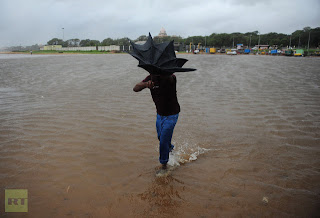
An Indian man wades through a flooded area in Chennai on October 31, 2012. (AFP Photo)

An Indian man wades through a flooded street in Chennai on October 31, 2012. (AFP Photo)

Onlookers gather on the beach after the oil tanker ship Pratibha Cauvery ran aground off the coast in Chennai on October 31, 2012. (AFP Photo/Seshadri Sukumar)

Photographed through the window of an ambulance, a crewmember of the oil tanker ship Pratibha Cauvery which ran aground receives treatment following his rescue off the beach in Chennai on October 31, 2012. (AFP Photo/Seshadri Sukumar)

A tree rests on top of a motor car following heavy winds in the run up to Cyclone Nilam in Chennai on October 31, 2012. (AFP Photo/Str)

Ambulances and police vehicles are seen on the beachfront after the oil tanker ship Pratibha Cauvery ran aground off the coast in Chennai on October 31, 2012. (AFP Photo/Seshadri Sukumar)

Women shield their faces during strong winds at Marina beach in the southern Indian city of Chennai October 31, 2012. (Reuters/Stringer India)
http://rt.com
In Hurricane Sandy's Fury, The Fingerprint Of Climate Change
Written By Unknown on Wednesday, October 31, 2012 | 8:07 PM

Residents along the East Coast are bracing for a storm that has prompted evacuations and shut down transit systems, schools and businesses. The map above shows the evolution of Hurricane Sandy's past and predicted path. Click the map for more.
Last month, Mike Tidwell, director of Maryland's Chesapeake Climate Action Network and the author of the 2006 book The Ravaging Tide -- which detailed the expected rise in extreme weather events that will come with global warming -- received a pamphlet in the mail from his insurance company, Travelers. The full-color flier depicted a typical suburban home with a lashing storm looming on the horizon.
Federal disaster declarations are up, the pamphlet declared. Average winter storm losses have doubled since the 1980s. Thunderstorms last year caused over $25 billion in damages, more than double the previous record.
"That flier was astonishing," said Tidwell. "I couldn't remember ever getting anything like that before."
The implication was simple: Given the bounty of scientific and statistical evidence now in hand, insurance companies can't afford to dither over whether climate change is real -- and really, neither can anyone else. Today, another multibillion-dollar weather disaster -- the very sort that scientists have been predicting for years would increase in frequency and intensity as the planet heats up -- is now bearing down on the American East Coast. Roads and subways and homes will flood and lives might well be lost (the death toll in the Caribbean already is as high as 65). Property damages from wind and storm surges could break records. And as many as 10 million people will likely lose power once Hurricane Sandy comes ashore somewhere along the New Jersey coast later tonight.
With one week left before an historic election that, as it happens, has been roundly criticized for its utter lack of high-level discussion of climate change, the smooth functioning of democracy itself might well be undermined by the storm, with the potential for widespread power outages in some areas lasting 10 days or more -- well beyond next Tuesday's scheduled polls.
If ever there was a time for everyone to wake up, Tidwell suggested, it's now.
"The irony is that the two presidential candidates decided not to speak about climate change, and now they are seeing the climate speak to them," said Tidwell. "That's really what's happening here. The climate is now speaking to them -- and to everyone else."
To be sure, a small but shrinking cadre of skeptics still question the basic mechanics of global warming -- including the likelihood that a hotter planet will produce more powerful and deadly storms like Sandy -- but the evidence is, once again, staring the nation in the face.
More than anything else, after all, hurricanes need warm ocean water, usually above 79 degrees Fahrenheit, to thrive. High humidity also adds fuel. Over the last several decades, both ocean temperatures and water vapor have increased in large part due to the burning of fossil fuels, which increases the amount of carbon dioxide and other so-called greenhouse gases in the atmosphere. Such gases act like a blanket around the planet, keeping the sun's heat from bouncing back out into space. That's an important phenomenon for sustaining life, of course, but too much of the blanket effect can make life as we've known it far more difficult.
Many scientists believe the atmospheric concentration of those gases must be kept below 350 parts per million to avoid dramatic and runaway changes in our climate. That benchmark has already been passed.
According to the latest measurements from the National Oceanic and Atmospheric administration, the average global temperature across land and ocean surfaces during September 2012 was 1.21 degrees above the 20th century average. That temperature ties with 2005 as the warmest September in the 133 years that records have been kept.
While scientists admit that unequivocally tying any one particular storm to climate change -- an area of research known as "event attribution science" -- is still very difficult, such hair-splitting is, in practical terms, nearly meaningless.
"We can't blame the existence of a single hurricane on global warming, just like a die weighted to roll sixes can't be blamed for any single roll of a six," said Michael Mann, a physicist and the director of the Earth System Science Center at Pennsylvania State University. Sixes, after all, will sometimes happen anyway, even when the dice aren't loaded, Mann explained.
"But we can see that climate change is playing a role in setting the context for these storms," Mann continued, "in particular the record levels of North Atlantic ocean warmth that is available to feed these storms with energy and moisture."
Kevin Trenberth, head of the Climate Analysis Section at the USA National Center for Atmospheric Research and one of the world's foremost experts on changes to global energy and water cycles, suggested in an email message that Hurricane Sandy represents the "new normal."
"Climate change is changing the weather," Trenberth said. "The past few years have been marked by unusually severe extreme weather characteristic of climate change. The oceans are warmer and the atmosphere above the oceans is warmer and wetter. This new normal changes the environment for all storms and makes them more intense and with much more precipitation."
Rising temperatures are also likely to intensify other storm phenomena. Thunderstorms may become less frequent but more intense, for example. And all that extra moisture also increases the threat of inland flooding, as happened after Hurricane Irene passed over the East Coast last year, contributing to the lion's share of roughly $16 billion in total damages. Add to this that the fact that ocean surges associated with such storms now ride on sea levels that have risen over the last century, and the potential for catastrophic losses is plain.
Which, of course, is why companies like Travelers are reaching out to customers like Tidwell to gently say, 'This stuff is real.' Indeed, the Travelers pamphlet is based on data compiled by the German reinsurance giant Munich Re, one of the largest reinsurance companies in the world. Just last week -- and only days before the first stirrings of Hurricane Sandy were detected in the South Atlantic -- the company produced a nearly 300-page report called "Severe Weather in North America."
According to the report, between 1980 and 2011, the overall losses from weather catastrophes was over $1 trillion in 2011 dollars -- including some $500 billion in insured losses. Hurricane Katrina itself accounted for some $125 billion in losses, according to the Munich Re analysis, and roughly 30,000 people "lost their lives due to weather catastrophes in North America" in the 30 years examined by the report.
"Nowhere in the world is the rising number of natural catastrophes more evident than in North America," the analysis declared. "The study shows a nearly quintupled number of weather-related loss events in North America for the past three decades, compared with an increase factor of 4 in Asia, 2.5 in Africa, 2 in Europe and 1.5 in South America."
In a statement accompanying the report's release, the Head of Munich Re’s Geo Risks Research unit, Peter Höppe, said, "In all likelihood, we have to regard this finding as an initial climate-change footprint in our U.S. loss data from the last four decades. Previously, there had not been such a strong chain of evidence.
"All stakeholders should collaborate and close ranks to support improved adaptation," Höppe added. "In addition, climate change mitigation measures should be supported to limit global warming in the long term to a still manageable level. As North America is particularly exposed to all kinds of weather risks, it especially would benefit from this."
Recent surveys suggest that most Americans now understand the connection between climate change and more severe weather, including a report released just last month by researchers at Yale and George Mason Universities. Among other things, that survey found that 74 percent of Americans agree that "global warming is affecting weather in the United States." That was up 5 points over the last time the question was asked in March.
Whether that popular concern, the risk modeling of insurance giants like Munich Re, or even the ravages of Sandy will nudge frank discussions of climate change to the front and center of the presidential campaign in its waning days, however, is unclear. On Friday, President Obama, in an appearance on the MTV network, fielded a question on the issue from a resident of New Jersey, a state that is staring right down the barrel of Hurricane Sandy.
"We're not moving as fast as we need to," the president said. "And this is an issue that future generations, MTV viewers, are going to have to be dealing with even more than the older generation. So this is a critical issue."
Obama highlighted many of the policies that his administration has pursued over the last four years to begin curbing greenhouse gas emissions, including tough new emissions standards for cars and trucks, and a doubling of wind and solar energy production. But he also said that the problem is compounded by forces beyond the nation's direct control, including increasing emissions in countries like China and India, who "feel that they have to prioritize getting people out of poverty ahead of climate change," the president said.
For his part, Mitt Romney has said little on the topic of global warming, admitting by turns that he believes it is happening but adding that he remains unconvinced about humanity's role in it -- evidenced, perhaps, by his fossil fuel-heavy energy plan for the next four years.
The Romney campaign did not respond to numerous requests for comment on the approach of Sandy and the implications of global warming.
Meanwhile, for Tidwell -- who, when reached by cell phone Monday morning, was busy buying groceries amid the throngs of other Washington, D.C., area residents who were preparing for Sandy -- said continued equivocation on the issue was absurd.
"We've warmed the planet," he said. "Everybody knows we've warmed the planet. So all super-storms are related to climate change now. You can't have a super-storm that's not related to climate change. Does everyone agree that the oceans have warmed? That land temperatures have increased? That there's more moisture in the air?" Tidwell posited. "The answer is yes. So it's impossible to have a super-storm that doesn't have the fingerprint of climate change on it."
www.huffingtonpost.com
Climate Change And Natural Disasters Related, Most Americans Say: Poll
Climate scientists have warned that more frequent hurricanes may be related to climate change, and a new HuffPost/YouGov poll finds that half of Americans think that climate change is indeed related to more frequent and severe natural disasters, although they are more divided on whether Hurricane Sandy specifically was related to global warming. According to the new survey, conducted Oct. 29-30, 51 percent of Americans say climate change is related to more frequent and severe natural disasters, while 23 percent say it is not. Republicans were the only demographic group in the survey in which more respondents said that more frequent and severe disasters were unrelated to climate change (51 percent) than those who said that the disasters were related to climate change (25 percent). Americans ages 65 and over were also somewhat less likely than other groups to say the two phenomena were related -- 40 percent said they were and 37 percent said they were not.


